Latest Recording









One professor in the department of music is determined to show students there’s more to orchestral music than works from “old, dead, European men.”
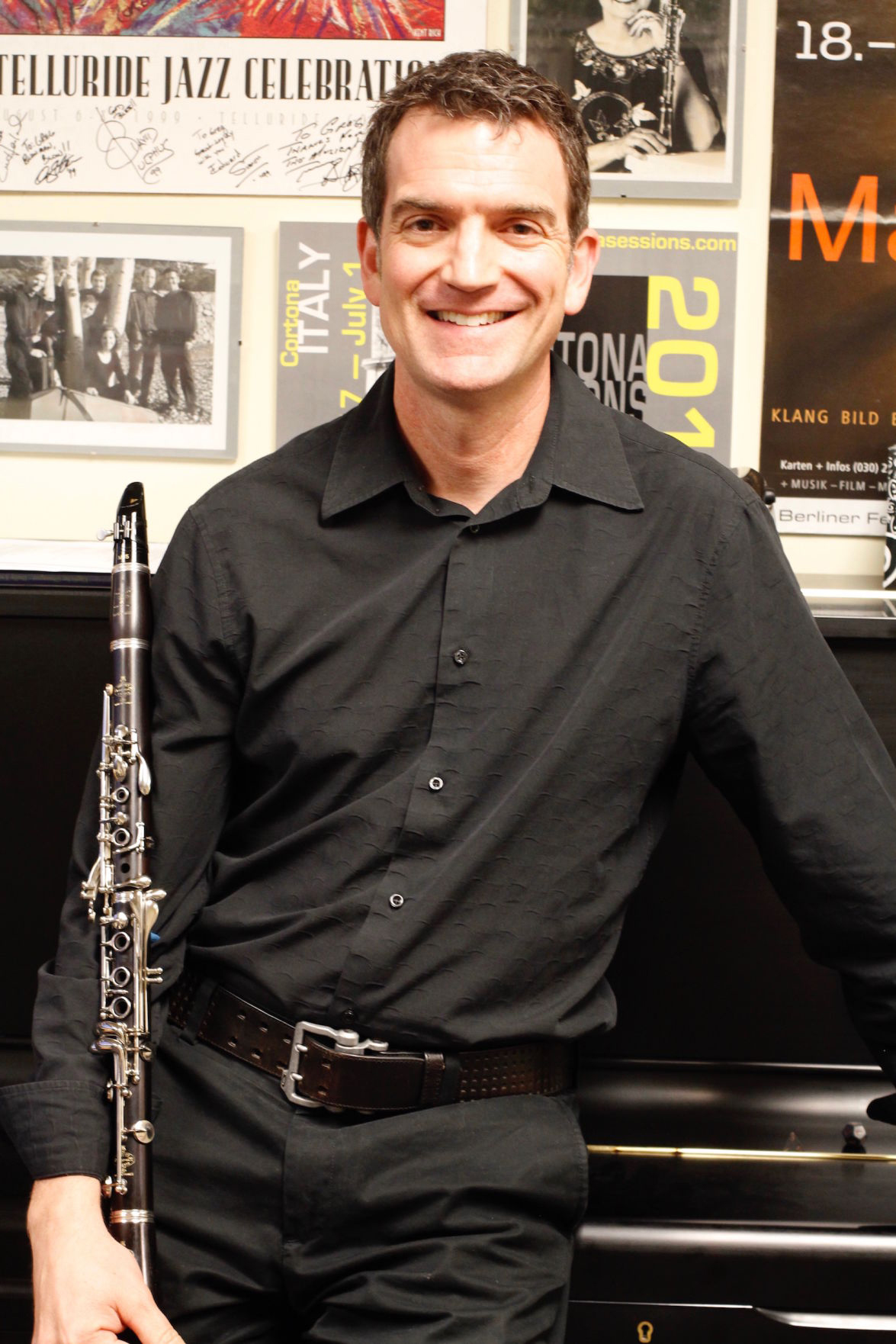
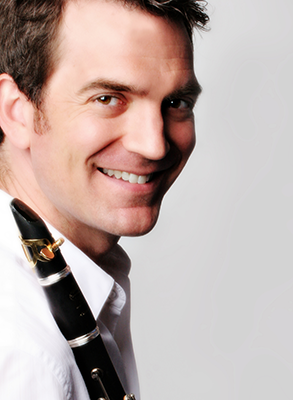
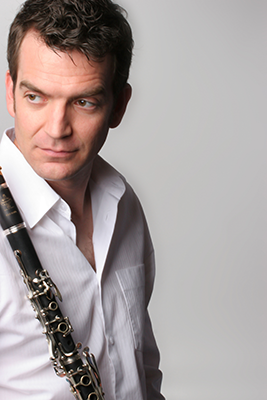
Gregory Oakes is an assistant professor of clarinet at Iowa State and the principal clarinet for the Des Moines Symphony. He focuses his attention on music written by living composers rather than what most people consider classical music. Read More>>
Dan Atwood, Iowa State Daily
Today I found the time and calm for listening to your marvelous performance of my “Dal Niente.” You are a great musician. This is not an easy piece. I myself always had problems with it, but now having heard your interpretation, I love it again (there is no better compliment). Now the piece has almost 50 years—but you made it totally fresh. Anyway, this is one of the best recordings—I think because of your incredible technique to change the articulation, and this has to do with a wonderful sense for the different sound (and noise) qualities. And—after all—it has to do with sensitivity and intelligence. Thank you so much.

Helmut Lachenmann (1935– ) is a composer who has been “on my radar” for some years now but, like a lot of names I get, I had yet to hear much of his music. Along comes Gregory Oakes from, of all places, Iowa. The Midwest in the United States doesn’t have much of a reputation for embracing the avant garde (though they actually do). So into the CD player goes this one and…wow, I really need to hear more Lachenmann and whoever this Oakes guy is I want to pay attention to what he is doing with that clarinet. Admittedly this disc languished a bit before I heard it but I am now glad I did.
This disc consists of only three tracks comprising three works by this major German composer from three different periods in his career. Dal Niente (Interiur III), Trio Fluido, and Allegro Sostenuto.
Dal Niente (1970) is for solo clarinet and, as the title prescribes, the music is to be played as “from nothing” the meaning of the title. In fact this seems to be practically a textbook of extended techniques for the clarinet. But far from being a dull accounting of dry techniques, this is a tour de force which will challenge the skills of even the most experienced players. It is quite musical and listenable but the virtuosity will knock your socks off. Oakes pulls it off with a deceptive ease that demonstrates his rather profound knowledge of his instrument. It is easy to see the seeming cross pollination between the avant garde and free jazz here.
Next up is Trio Fluido (1966–68) which is a respectably avant garde trio for clarinet, viola, and percussion with Matthew Coley, percussion, and Jonathan Sturm, viola. Like the previous work this one is also about extended techniques (for all three instruments this time). This is a fine example of mid-twentieth century modernism and deserves a place in the repertoire. All three musicians are challenged to play their instruments in unconventional ways and the effect is almost like some of the electronic music of the era. It is a complex and pointillistic texture that has a strong and serious content.
Finally Allegro Sostenuto (1986–88) is another trio, this time for clarinet, cello, and piano. So while this work would make a fine companion work to the Brahms clarinet trio the work is unambiguously avant garde in the finest Darmstadt traditions. It is, at about 30 minutes, the longest piece here and it reflects the further maturity of the composer as he creates another challenging but almost surprisingly satisfying work.
This album serves as a nice way to be introduced to Helmut Lachenmann and to get to know some major new champions of the avant garde. And one would do well to stay informed about the work being done by this fine new music clarinetist.
v
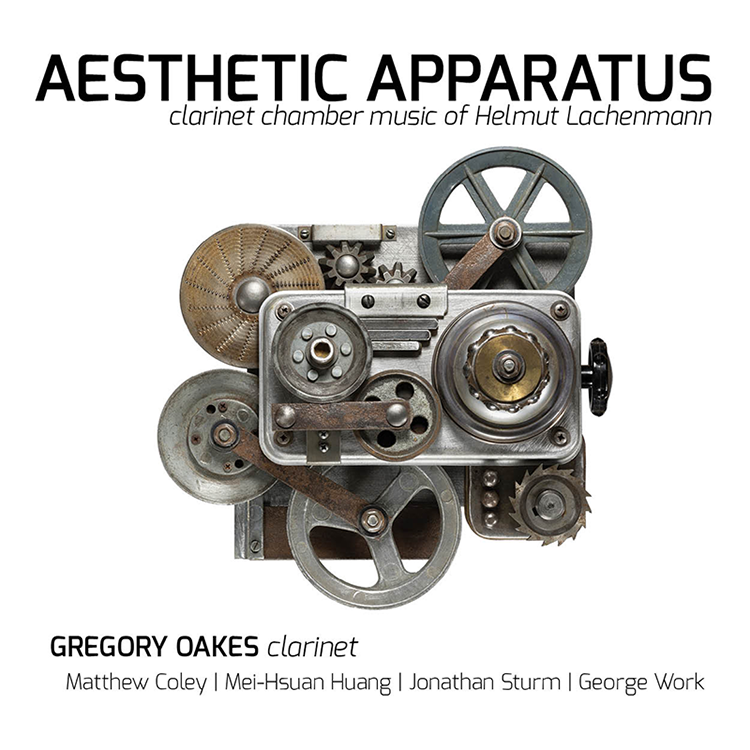
Some of the most challenging music of recent years—challenging to play as well as to listen to—has been written by German composer Helmut Lachenmann (b. 1935). The conceptual core of much of his music has consisted in laying bare the conditions underlying and assumed by music production—essentially, the physical prerequisites of performance practice, as well as the determinations, both accepted and rejected, of genre. For Lachenmann, musical sound is a complex of factors reaching back within the tradition or genre in relation to which it is created, and reaching forward into the moment—the physical situation of specific possibilities and the choices they elicit—in which it is actually produced. Thus the title of his book of writings, which translates as “music as existential experience.” This standpoint puts extraordinary demands on the performer, who must be familiar with all the aspects and resources his or her instrument has to offer. With Aesthetic Apparatus, a set of three Lachenmann compositions, clarinetist Gregory Oakes takes up the challenge.
Oakes, who is principal clarinetist for the Des Moines Symphony Orchestra as well as an assistant professor of clarinet at Iowa State University in Ames, is particularly interested in contemporary art music. Much of his repertoire is the product of collaboration with currently active composers, and he seems especially drawn to new music that assumes a broad notion of what kinds of sounds are permissible in the concert hall. Thus Lachenmann’s music is a natural fit for him.
The affinity between Oakes and Lachenmann’s sound world is immediately apparent with the first piece, 1970’s Dal Niente (Interieur III) for solo clarinet. The composition calls for a number of extended techniques for the instrument, many of which involve the sounds of breath on the borderline of silence. In his liner note, Oakes points out that the title of the piece derives from a musical marking that translates as “from nothing;” his performance accordingly pivots on the flux of sounds proceeding from and returning to nothing. The Trio Fluido for clarinet, viola and percussion of 1966, in which Oakes is joined by violist Jonathan Sturm and Matthew Coley on marimba, also centers on sound but in a more assertive way. The piece begins with a fragmented Modernist counterpoint that, through a kind of compositional auto-deconstruction, gradually dissolves into abstract sound. What’s striking about the piece is its underlying consistency; the division of the three voices focuses attention on their individual timbral characteristics, whether played conventionally or with the extended techniques that come to dominate the final third or so of the performance. The interplay among the three performers manages to be both refined and (subtly) dramatic. The final performance, the nearly 32 minute long Allegro Sostenuto (1986/1988), is a trio for clarinet, cello (George Work) and piano (Mei-Hsuan Huang) that Lachenmann has described as mediating between resonance and movement. The piece begins as an archipelago of rapid bursts, truncated phrases and points of sound that accumulate and build length and mass over time. The resonance inheres in the individuation of each of the three instruments, which is helped by the three players’ precise articulation. Here as on all three pieces, Oakes plays with a fine-grained, well-modulated and vivid sound.
Daniel Barbiero
Utter the name Helmut Lachenmann in a loud stage whisper, being sure to accentuate fully the consonants, exaggerating the different vowel colours, and you’ll have an idea what it is like to perform his music. He asks performers to make varying sounds which require a complete rethinking of one’s technical approach. Lachenmann, Maurizio Kagel and Heinz Holliger have led the way to innovative notations depicting the strange breath effects, kisses, clicks, squeaks and honks they demand from performers.
In Aesthetic Apparatus, clarinetist Gregory Oakes has compiled three substantial chamber works by Lachenmann. The first, Dal Niente, for solo clarinet, is an extension of silence into a variety of soundscapes. Oakes conveys conviction that all the sounds he generates belong in a congruent whole, and with more hearings I’m certain I’d agree. What is unusual in this recording is the extended periods of nearly empty time, where the effects produced might be more easily perceived if one could see them produced. It takes chutzpah to publish this performance on a sound-only recording.
Trio Fluido, for clarinet, viola and percussion, provides a richer soundscape, although the writing is still full of attenuated pauses. Early exchanges between the instruments seem full of repressed violence, which occasionally breaks out into outright hostility. Beyond this, there are delightful moments of simply elegant trialogue, as if three species of creature are employing their various intelligences to match one another’s language.
Allegro Sostenuto, for clarinet, cello and piano, completes this wonderful exploration. I use the term “tonal” modified by “somewhat more” to indicate that in contrast to the first two tracks, this work exploits more interplay between pitches than raw sounds, making it perhaps the most immediately listenable.
Max Christie
Iowa State University professor and contemporary music specialist Gregory Oakes presents a recital of mostly unaccompanied clarinet works, most or which call on extended techniques and world music. The program consists of Southern Illinois University faculty member and clarinetist-composer Eric Mandat’s Folks Songs (1986); University of California at Berkeley professor Ken Ueno’s I screamed at the sea until nodes swelled up, then my voice became the resonant noise of the sea (2009) for amplified clarinet; Puerto-Rican born post-modernist Roberto Sierra’s Cinco Bocetos (1984); Chinese composer Chen Yi’s Monologue (1993); Amsterdam-based American flutist Ned McGowan’s Ios Duo (2000) for flute and clarinet, where McGowan serves as a guest performer; the 20th Century Indian violinist and Indo-Jazz fusion composer John Mayer’s Raga Music (1957); and Swiss cellist-composer Alfred Felder’s Apache Clown Dance (1998).
Some avant-garde performers delve into their genre to downplay a lack of fundamentals, but Oakes is the rare player who has both excellent classical training and a mastery of the otherworldly procedures demanded by non-traditional repertoire. He boasts a clear sounds, clean fingers, wide dynamic range, and a deep understanding of the simple yet expressive folk idioms behind the notes. He meets all the technical and artistic challenges of more traditional repertoire like the Sierra, where the composer leaves no room to hide, and easily transcends the obstacles laid out in the scores by Mandat, Ueno, McGowan, Yi, and Felder, employing extreme volume, pitch bending, flutter-tonguing, key-slapping, foot-stomping, circular breathing, and eye-popping multiphonics with seemingly little effort. His low register in the Mayer is more reedy than in the rest of the program, but that may be an attempt to give a more “earthy” sound to the piece. If so, it works.
Hanudel
This disc is likely to find a place only in clarinetist’s shelves, given its nearly exclusive instrumentation of solo clarinet. This would be a pity, since there is much to enjoy for anyone interested in the wanderings of contemporary music in the last couple of decades, and indeed for those whose sole criteria is quality music realized at a high level. Besides its intrinsic musical value, I could scarcely imagine a better primer on clarinet possibilities for the budding composer.
If Eric Mandat’s Folk Songs from 1986 hasn’t become a mainstay in contemporary music, there is no justice in the music world. Just the opening bars brought back fond memories, as I recalled hearing the composer play it a number of times many years ago, and his disc of solo clarinet music from two decades ago remains a favorite in the genre. Mandat was not the first to explore extended clarinet techniques and bring non-Western influences to his instrument, but few (if any) have synthesized these strains in such a controlled and compelling way. I was doubtful that anyone other than the composer could do justice to these very personal works, but Gregory Oakes has made them his own, and deserves credit for bringing them to a wider audience.
Like the Mandat work, Ken Ueno’s solo work is keen to explore many non-traditional sounds, including “difference tones”, humming, multiphonics, and key clicks. I have little patience for those that maintain that an instrument should not attempt anything other than what its inventors intended, and I would hope any open-minded listener would give Ueno’s fascinating piece a try. One mission of these sonic explorations is to give the illusion of multiple voices, thereby increasing the possibilities of unaccompanied “single line” instruments like the clarinet.
The five movements of Roberto Sierra’s Cinco Bocetos are less concerned with timbral explorations than simple embodiments of the musical flavors of Puerto Rico. Still, he senses the potential pitfalls of a solo wind instrument, and uses well-crafted changes of register to give the illusion of multiple voices (like Bach’s solo works for single line instruments such as the violin, cello, and flute). Chen Yi’s haunting Monologue packs a multiplicity of voluminous ideas into a small package. It might seem unlikely that she could distill her impressions of a true story by writer Lu Xun into a mere four minutes, but she does so with consummate skill and idiomatic use of the instrument.
Flutist and composer Ned McGowan joins Oakes for the former’s Ios Duo, which among other things explores bends of pitches within close intervals between the pair, as well as gentle cross-rhythms and melodies suffused with microtonal inflections. John Mayer’s Raga Music, with its brief movements and Eastern references could be viewed as a precursor to Mandat’s Folk Songs, minus the latter’s extended techniques. The barn-burning finale is Arthur Felder’s Apache Clown Dance, a picturesque, virtuosic, and thoroughly engrossing depiction of a dance ritual.
Splendid playing throughout, and the recorded sound is close, clear, and a bit on the dry side.
Michael Cameron
* * *
This is a good issue for avant-garde clarinet recitals. Elsewhere in these pages I review a disc called Necessity by Argentinean composer-performer Jorge Variego, and now here’s one by an American (I think) player with a long curriculum vitae, including a current faculty position at Iowa State University, where most of this CD was recorded.
As with Variego’s disc, New Dialects seems destined to appeal primarily to those who eat, sleep, and live the clarinet. While Necessity frequently combined the clarinet with other instruments or electronics, New Dialects is a solo gig, save for the 12-minute Ios Duo, in which Oakes is joined by the composer. Extended playing techniques are integral to the music on both discs, and on New Dialects you will hear textbook examples of multiphonics, microtonal playing, key noises, singing into the instrument, blowing into it in unusual ways, and the like. Sometimes these techniques seem to have been incorporated into the music merely for the sake of making things harder or more intriguing for musicians and audiences alike. At other times, such as in Eric P. Mandat’s Folk Songs, their impact more than justifies their presence.
Ken Ueno’s work should win an award for the length of its title, which also pretty much describes what it sounds like. (The “nodes” in question are those that sometimes grow on vocal cords as a result of vocal strain.) Do you remember Yoko Ono’s vocal feats on the Live Peace in Toronto, 1969 album? (All right, I am dating myself.) If you had the fortitude to enjoy that, you’ll probably respond as positively to Ueno’s work. About Ios Duo, McGowan writes, “The entire piece is microtonal, incorporating glissandos within various quarter-tone systems.” Again, as an exercise in de natura sonoris, it will have its admirers, but parts of it will be tough sledding for conservative listeners.
Monologue can be heard as a short story or essay without words. Subtitled “Impressions on The True Story of Ah Q,” it invites the listener (should he or she so wish) to reflect on “ignorance and civilization, lowliness and pride.” I believe boceto means “sketch” in Spanish, and Roberto Sierra’s set of five of them, only one more than two minutes long, evokes his Puerto Rican homeland. These terse but colorful vignettes in a tonal style make their point and step aside. The components of John Mayer’s Raga Music take a similar approach to Indian classical music, although they lack that genre’s leisurely progress: we are given nine of them in a little more than ten minutes. Alfred Felder’s Apache Clown Dance is inspired by a sacred Native American tradition in which entertainment, purification, and healing are combined. I don’t know if any of the material is authentic, but the mental picture Felder’s work creates is vivid enough.
The works chosen for this CD demonstrate the continued synergy between “world music” and classical music. Furthermore, they demonstrate that the world’s musical traditions are anything but fragile, and can endure and even respond positively to manipulation via cutting-edge classical techniques. Gregory Oakes obviously has a formidable technical armamentarium at his command, and the laudable curiosity to extend his repertory… and ours as well. As with Variego’s Necessity CD, New Dialects is not for everyone (although I think it is the friendlier disc of the two), but I’m grateful it exists.
Raymond Tuttle
Download long bio (567 words) | Download short bio (217 words)
Gregory Oakes is an exciting and energetic clarinetist and a passionate champion of the music of our time. From his Carnegie Hall debut with members of Ensemble Intercontemporain and Pierre Boulez to his performances as a member of the Colorado Symphony Orchestra, Mr. Oakes has been praised by critics for his “outstanding performance” (New York Times) and “jazzy flourishes”(Denver Post). American Record Guide says “Oakes is the rare player who has both excellent classical training and a mastery of the otherworldly procedures demanded by non-traditional repertoire,” and Fanfare Magazine lauds the “formidable technical armamentarium at his command.”
A flexible and versatile musician, Mr. Oakes has performed with notable musicians in prestigious venues around the world. He has been a concerto soloist with the Colorado Symphony Orchestra and the Denver Brass, performed with Grammy® Award-winner Terence Blanchard at the Telluride Jazz Festival, and appeared at the Chicago Arts Club. His recordings have been released on Bridge, Centaur, CRI, Karnatic Lab Records, and Naxos and broadcast on National Public Radio. His recent CD, Aesthetic Apparatus: Clarinet Chamber Music of Helmut Lachenmann, is available on the New Focus Recordings label.
As a soloist, Mr. Oakes has performed at multiple International Clarinet Association ClarinetFests, the University of Oklahoma Clarinet Symposium, the International Computer Music Conference, the Crested Butte Chamber Music Festival, Boulder’s Modern Music Festival (M2F), and the Pendulum New Music Series. An international artist, Mr. Oakes has performed frequently in the Netherlands at Amsterdam’s venerable new music hall De IJsbreker, the Gaudeamus Music Week, Concerten Tot en Met, the Karnatic Lab concert series, De Badcuyp, STEIM, and Utrecht’s Theatre Kikker. He has been a featured soloist at the prestigious MaerzMusik festival in Berlin. He has also toured Brazil—performing in Brasília, Rio de Janeiro, and Campinas—and conducted masterclasses at notable Brazilian universities UnB, UNIRIO, and UNICAMP. He was in residence as a guest artist at the MUPA Festival of Contemporary Music in Bangsaen, Thailand. In the summer, Mr. Oakes is on the faculty of The Cortona Sessions festival for new music in Tuscany, Italy.
Mr. Oakes has been a member of several orchestras including the Colorado Symphony Orchestra, Mississippi Symphony Orchestra, Colorado Ballet, Central City Opera, and the Colorado Music Festival. He is currently the principal clarinet of the Des Moines Symphony Orchestra. He is also an active chamber musician. As a founding member of the new music and creative arts ensemble Non Sequitur, he has been in residence at Princeton, Harvard, Dartmouth, and the Aspen Music Festival. Oakes has also performed as a member of the woodwind quintet Category 5 and the award-winning clarinet quartet Ensemble Syzygy.
Mr. Oakes holds a bachelor’s degree from Michigan State University, a master’s degree from DePaul University, and a doctorate from the University of Colorado. His teachers include Bil Jackson, Elsa Ludewig-Verdehr, and John Bruce Yeh. He has been honored as an Aspen Music Festival Fellow, a Tanglewood Music Festival Fellow, and a Fulbright Scholar Finalist. Mr. Oakes has presented masterclasses at numerous institutions including the University of Michigan, University of California Berkeley, Peabody Conservatory, the Amsterdam Conservatory, and the Aspen Music Festival. He has previously taught at the University of Southern Mississippi (Hattiesburg, MS) and Bemidji State University (Bemidji, MN). Mr. Oakes is on the faculty of Iowa State University (Ames, IA).
Gregory Oakes is a Buffet Group USA and a Vandoren Performing Artist.
| Aesthetic Apparatus $15 | |
| New Dialects $15 | |
| Aesthetic Apparatus + New Dialects package $20 (best value!) |
| 8.1.2024 | 4:00pm ICA Recital Works by Cox, Farrin, and Russell | Dublin, Ireland |
| 3.21.2024 | The Electric Belle at Stovehouse Works by Akiho, Hearne, Mazzoli, and O'Halloran | Huntsville, AL |
| 9.12.2023 | Princeton University Dixon, Ge, Gorman, Lyuh, Morrison, Peacocke | Princeton, NJ |
| 9.10.2023 | DiMenna Center Works by Davis, O'Halloran, Ricketts, and Thompson | New York, NY |
| 7.8.2023 | ICA Conference Ken Thomson: How to Play | Denver, CO |
| 7.6.2023 | ICA Conference Works by McGowan and Cuong | Denver, CO |
| 2.26.2023 | Epiphany Center for the Arts Boyce, Martin, McGowan, Montgomery, and Thomas | Chicago, IL |
| 12.1.2022 | Northwestern University Lake Heritage Quartet | Evanston, IL |
| 11.30.2022 | Constellation Lake Heritage Quartet | Chicago, IL |
| 11.27.2022 | Muziekgebouw aan ‘t IJ Works by McGowan, Alves, Dumitrescu, and Rutty | Amsterdam, Netherlands |
| 10.23.2022 | MU Microtonal Clarinet Festival | Online |
| 7.2.2022 | ICA Conference Premieres by Kirsten Broberg and Alan Theisen | Reno, NV |
| 6.3.2022 | Cortona Sessions Cox: Light-Dots on a Deep-Space-Image | Tallahassee, FL |
| 5.29.2022 | Cortona Sessions Works by Eastman and Davies | Tallahassee, FL |
| 5.27.2022 | Cortona Sessions Works by Luc and Epstein | Tallahassee, FL |
| 5.25.2022 | Cortona Sessions Viet Cuong: Wax and Wire | Tallahassee, FL |
| 5.23.2022 | Cortona Sessions Evan Williams: the waters wrecked the sky | Tallahassee, FL |
| 5.13.2022 | CNMAT Works by Ueno, Cox, Pierce, and Soriano-Broberg | Berkeley, CA |
| 4.24.2022 | Ames City Auditorium Artie Shaw Concerto | Ames, IA |
| 8.19.2021 | Livestream Apostrophe | |
| 8.13.2021 | Landmark Center Jessie Cox: Light-Dots on a Deep-Space Image | Minneapolis, MN |
| 6.30.2021 | International Clarinet Association Conference Kirstin Broberg, Jessie Cox, and Suzanne Farrin | Fort Worth, TX |
| 4.9.2020 | University of California, Berkeley | Berkeley, CA |
| 2.13.2020 | Horace Mann School Works by Akiho and Schober | New York, NY |
| 2.12.2020 | Horace Mann School Works by Cuong and Mandat | New York, NY |
| 7.24.2019 | University of Tennessee Knoxville Lachenmann: Dal niente (Interieur III) | Knoxville, TN |
| 5.20.2019 | Sala Neumann Atkinson: manyhanded body | Cortona, Italy |
| 4.6.2019 | Applause Concert Series Atkinson, Cuong, Harrison, Lachenmann, Poston | Dallas, TX |
| 2.3.2019 | Constellation Atkinson, Bacon, Cuong, Farrin, Lachenmann, Pierce | Chicago, IL |
| 11.9.2018 | Hammert Building Works by Cuong, Farrin, Lachenmann, Pierce | Eudora, KS |
| 11.3.2018 | DePaul University | Chicago, IL |
| 10.28.2018 | Des Moines Civic Center Bernstein: Prelude Fugue and Riffs | Des Moines, IA |
| 10.27.2018 | Des Moines Civic Center Bernstein: Prelude Fugue and Riffs | Des Moines, IA |
| 10.7.2018 | Cluskey Vaults Ueno: Ghost Vault | Savannah, GA |
| 10.6.2018 | Cluskey Vaults Ueno: Ghost Vault | Savannah, GA |
| 9.14.2018 | Sheslow Auditorium Cage: Musicircus | Des Moines, IA |
| 8.18.2018 | Sheslow Auditorium Shoenfield | Des Moines, IA |
| 7.27.2018 | Principal Group Financial Campus Mozart, Weber | Des Moines, IA |
| 5.29.2018 | Cortona Sessions for New Music Pierce: Prima Materia, Cuong: Wax and Wire | Cortona, Italy |
| 5.23.2018 | Cortona Sessions for New Music Farrin: ma dentro dove | Cortona, Italy |
| 5.20.2018 | Cortona Sessions for New Music Mandat: Folk Songs | Cortona, Italy |
| 4.21.2018 | Northwestern University New Music Conference Lachenmann: Dal niente (Interieur III) | Evanston, IL |
| 1.26.2018 | SPLICE Festival Erik Spangler: Devonian Geometry | Kalamazoo, MI |
| 1.19.2018 | Martha-Ellen Tye Hall Ueno, Lachenmann, Farrin, Cuong, and Mandat | Ames, IA |
| 10.6.2017 | Martha-Ellen Tye Hall Kinan Azmeh: The Wedding | Ames, IA |
| 10.1.2017 | Iowa West High School Kinan Azmeh: The Wedding | Iowa City, IA |
| 9.27.2017 | Martha-Ellen Tye Hall David Taddie: Licorice Stick Groove | Ames, IA |
| 7.29.2017 | ClarinetFest 2017 Folk Songs | Orlando, FL |
| 7.28.2017 | ClarinetFest 2017 Mackey: Damn | Orlando, FL |
| 7.14.2017 | Cortona Sessions for New Music Todd Kitchen: Noiseful | Cortona, Italy |
| 7.14.2017 | Cortona Sessions for New Music Boulez: Dérive | Cortona, Italy |
| 7.13.2017 | Cortona Sessions for New Music Forrest Pierce: On the Fermentation of Honey | Cortona, Italy |
| 7.11.2017 | Cortona Sessions for New Music Viet Cuong: Apparition | Cortona, Italy |
| 7.8.2017 | Cortona Sessions for New Music Carter: Esprit Rude, Esprit Doux | Cortona, Italy |
| 7.5.2017 | Sala Neumann Berio Sequenza IXa | Cortona, Italy |
| 5.12.2017 | New Music Gathering Viet Cuong: Apparition (world premiere) | Bowling Green, OH |
| 5.7.2017 | Greater Grand Forks Symphony Orchestra Mozart Clarinet Concerto | Grand Forks, ND |
| 3.25.2017 | Simpson College Lachenmann: Dal Niente | Indianola, IA |
| 10.14.2016 | University of Maryland, College Park | College Park, MD |
| 10.10.2016 | Peabody Conservatory | Baltimore, MD |
| 9.30.2016 | Martha-Ellen Tye Hall Beethoven Trio Op. 11 | Ames, IA |
| 9.28.2016 | Sheslow Auditorium Beethoven Trio Op. 11 | Des Moines, IA |
| 8.28.2016 | Martha-Ellen Tye Hall Carter Gra | Ames, IA |
| 8.19.2016 | Zenith Chamber Music Festival Brahms Trio | Des Moines, IA |
| 8.17.2016 | Zenith Chamber Music Festival Glazunov | Des Moines, IA |
| 5.24.2016 | Southern Illinois University Carbondale Folk Songs | Carbondale, IL |
| 5.1.2016 | Ames City Auditorium Copland Clarinet Concerto | Ames, IA |
| 4.2.2016 | Central College Lachenmann: Dal Niente | Pella, IA |
| 2.26.2016 | Martha-Ellen Tye Hall Ueno: Rapt Afterness | Ames, IA |
| 1.8.2016 | Peabody Conservatory Lachenmann, Mandat, Ueno | Baltimore, MD |
| 1.6.2016 | Baltimore Boom Bap Society, Windup Space Improvisation | Baltimore, MD |
| 9.29.2015 | Des Moines Social Club Mantovani: Bug | Des Moines, IA |
| 2.13.2015 | Martha Ellen Tye Hall Works by Carter and Scelsi | Ames, IA |
| 10.18.2014 | Martha Ellen Tye Recital Hall Works by Bartók & Stravinsky | Ames, IA |
| 3.21.2014 | The Firehouse Space Smaldone, Schober, Füting, Scelsi and more | Brooklyn, NY |
| 3.4.2014 | Chillicothe High School Weber Concertino | Chillicothe, MO |
| 2.23.2014 | Martha Ellen Tye Recital Hall George Tsontakis: Eclipse | Ames, IA |
| 2.1.2014 | Sheslow Auditorium, Drake University Works by Gunnar Berg, Zoltan Paulinyi, James Romig | Des Moines, IA |
| 10.2.2013 | Martha Ellen Tye Recital Hall Improvisation | Ames, IA |
| 9.16.2013 | Sheslow Auditorium, Drake University Mozart Kegelstadt Trio & Wolff Exercises | Des Moines, IA |
| 9.8.2013 | Martha Ellen Tye Recital Hall Scelsi: Preghiera per un'ombra | Ames, IA |
| 6.30.2013 | The Cortona Sessions Works by Frank, Pierce, & Scelsi | Cortona, Tuscany |
| 6.26.2013 | The Cortona Sessions Ueno: I screamed at the sea until nodes swelled up, then my voice became the resonant noise of the sea | Civitella Ranieri, Tuscany |
| 6.20.2013 | The Cortona Sessions Ueno: I screamed at the sea until nodes swelled up, then my voice became the resonant noise of the sea | Cortona, Tuscany |
| 4.24.2013 | Martha-Ellen Tye Recital Hall John Mackey: Damn | Ames, IA |
| 4.14.2013 | Des Moines Civic Center Krommer Concerto for Two Clarinets | Des Moines, IA |
| 4.13.2013 | Des Moines Civic Center Krommer Concerto for Two Clarinets | Des Moines, IA |
| 3.26.2013 | Popejoy Hall Music of Ken Ueno | Albuquerque, NM |
| 1.12.2013 | Oklahoma State University Single Reed Summit Carter: Gra | Stillwater, OK |
| 11.24.2012 | Burapha University Blackbox Theatre Crackle Box Ritual | Burapha, Thailand |
| 11.5.2012 | University of Michigan Works by Carter, Chen, Hindemith, Kreiger, & Ueno | Ann Arbor, MI |
| 9.14.2012 | Drake University Works by Gavin Bryars, Arthur Kreiger | Des Moines, IA |
| 8.3.2012 | International Clarinet Association Clarinetfest Finnissy: Uzundara | Lincoln, NE |
| 3.31.2012 | Iowa Clarinet Day Mantovani: Bug | Pella, IA |
| 3.16.2012 | STEIM Concept Stage Ueno: Cracklebox Ritual | Amsterdam, Netherlands |
| 3.10.2012 | Opensound Series Ueno: Cracklebox Ritual | Boston, MA |
| 2.16.2012 | Oklahoma State University New Music Festival Ueno: I screamed at the sea until nodes swelled up, then my voice became the resonant noise of the sea | Stillwater, OK |
| 8.3.2011 | International Clarinet Association ClarinetFest Works by Mantovani and Scelsi | Los Angeles, CA |
| 6.20.2011 | The Cortona Sessions Works by Chen, Mandat, Ueno, & others | Cortona, Tuscany |
| 3.27.2011 | MaerzMusik Festspiel Ueno: I screamed at the sea until nodes swelled up, then my voice became the resonant noise of the sea | Berlin, Germany |
| 3.6.2011 | Martha Ellen Tye Recital Hall Works by Berkhout, Hollinden, Piazzola, & Prangcharoen | Ames, IA |
| 10.16.2010 | Iowa Composers' Forum Works by Bryden, Wray, Yip, & Zubow | Ames, IA |
| 10.12.2010 | University of Nebraska, Lincoln Works by Carter and Chen | Lincoln, NE |
| 9.24.2010 | Martha Ellen Tye Recital Hall Weber Concerto #2 with the ISU Symphony | Ames, IA |
| 4.11.2010 | Martha Ellen Tye Recital Hall Works by Bach, Brahms, & Debussy | Ames, IA |
| 2.23.2010 | Ithaca College Works by Mandat, Chen, Kreiger, Sierra, & Ueno | Ithaca, NY |
| 12.4.2009 | Martha Ellen Tye Recital Hall Works by Bogojevich, Minchew, Ruggiero, Theisen, & Ueno | Ames, IA |
| 11.17.2009 | Lipa Festival of Contemporary Music Scott Miller: Lovely Little Monster | Ames, IA |
| 10.23.2009 | DePaul University Works by Mandat, Chen, & Sierra | Chicago, IL |
| 9.19.2009 | Iowa Clarinet Day Schumann: Romance | Ames, IA |
| 6.26.2009 | University of Oklahoma Clarinet Symposium Works by Davidovsky, Kreiger, & Ruggiero | Norman, OK |
| 5.15.2009 | Iowa Bandmasters' Convention McAllister: Black Dog | Des Moines, IA |
| 3.17.2009 | The Karnatic Lab, De Badcuyp Chen, Felder, Mandat, McGowan, & Sierra | Amsterdam, Netherlands |
| 2.28.2009 | Big 12 Clarinet Day Eric Mandat: Folk Songs | Ames, IA |
| 2.14.2009 | Ames Town and Gown Winter Musicale Schumann: Three Romances | Ames, IA |
| 1.23.2009 | PianoForte Salon Series WFMT Works by Frank & Garrido-Lecca | Chicago, IL |
| 12.10.2008 | University of California Berkeley UC Berkeley Student Compositions | Berkeley, CA |
| 12.8.2008 | University of California Berkeley UC Berkeley Student Compositions | Berkeley, CA |
| 12.5.2008 | Ames City Auditorium McAllister: Black Dog | Ames, IA |
| 11.6.2008 | Martha Ellen Tye Recital Hall Works by Fiege, Frank, Garrido-Lecca, Guerra-Peixe, Sierra, Tacuchian, & Villa-Lobos | Ames, IA |
| 10.23.2008 | Lipa Festival of Contemporary Music Arthur Kreiger: Uncommon Bonds | Ames, IA |
| 9.29.2008 | University of California Berkeley Contemporary Techniques Masterclass | Berkeley, CA |
| 9.15.2008 | Louisiana State University Brahms: Quintet | Baton Rouge, LA |
| 9.14.2008 | Parkway Heights Brahms: Quintet | Hattiesburg, MS |
| 9.6.2008 | Iowa Clarinet Day Paganini: Moto Perpetuo | Pella, IA |
| 7.5.2008 | International Clarinet Association ClarinetFest Eric Mandat: Folk Songs & Chen Yi: Monologue | Kansas City, MO |
| 4.4.2008 | Marsh Auditorium Works by Brahms, Prokofiev, & Schubert | Hattiesburg, MS |
| 3.9.2008 | University of Kansas Clarinet Day Works by Carter, Chen, Mandat, & Mayer | Lawrence, KS |
| 2.23.2008 | University of Montevallo Works by Chen & Mandat | Montevallo, AL |
| 2.16.2008 | New Pioneers Music Festival Ortiz: Milonguitas | Laramie, WY |
| 2.16.2008 | New Pioneers Music Festival Works by Carter, Chen, Mandat, & Ueno | Laramie, WY |
| 11.23.2007 | University of Campinas - UNICAMP Works by Devienne, Mandat, Persichetti, & Telemann | Campinas, Brazil |
| 11.22.2007 | University of Rio de Janerio - UNIRIO Works by Devienne, Mandat, Persichetti, & Telemann | Rio de Janeiro, Brazil |
| 11.20.2007 | University of Brasília - UNB Works by Devienne, Mandat, Persichetti, & Telemann | Brasília, Brazil |
| 11.10.2007 | Elsa Ludewig-Verdehr Tribute Concert Eric Mandat: Folk Songs | East Lansing, MI |
| 10.31.2007 | Marsh Auditorium Carter: Esprit Rude/Esprit Doux | Hattiesburg, MS |
| 4.22.2007 | Gaudeamus Interpreters' Competition Works by Altena, Berio, Carter, Janssen, Mandat, Stravinsky, & Ueno | Amsterdam, Netherlands |
| 3.2.2007 | Marsh Auditorium Altena, Berio, Carter, Mendelssohn, & Villa-Lobos | Hattiesburg, MS |
| 2.16.2007 | Eastern Michigan University Works by Altena, Berio, Carter, & Mandat | Ypsilanti, MI |
| 2.13.2007 | Michigan State University Works by Carter & Mandat | East Lansing, MI |
| 12.8.2006 | Mississippi Bandmasters' Conference Gould: Derivations & Paganini: Moto Perpetuo | Tupelo, MS |
| 12.7.2006 | Bennett Auditorium Morton Gould: Derivations | Hattiesburg, MS |
| 11.17.2006 | Southeastern Louisiana University Works by Bartók, Berio, Gould, Mandat, & Paganini | Hammond, LA |
| 11.6.2006 | Tulane University Shu Matsuda: Enlargement for Bass Clarinet & Computer | New Orleans, LA |
| 8.11.2006 | International Clarinet Association ClarinetFest Ueno: I screamed at the sea until nodes swelled up, then my voice became the resonant noise of the sea | Atlanta, GA |
| 5.6.2006 | Intégrales New Music Festival Works by Phillip Schroeder | Hattiesburg, MS |
| 3.20.2006 | University of New Mexico Works by Mandat, Paganini, & Smith | Albuquerque, NM |
| 3.9.2006 | Marsh Auditorium Bartók, Mandat, Nielsen, Paganini, & Smith | Hattiesburg, MS |
| 2.24.2006 | University of North Carolina Works by Mandat, Paganini, & Smith | Chapel Hill, NC |
| 10.16.2005 | Concerto with the Bemidji Symphony Orchestra Mozart Clarinet Concerto | Bemidji, MN |
| 4.24.2005 | Western Carolina University Works by Mandat, Martino, Osborne, Poulenc, Smith, Sutermeister, Stravinsky, & Tower | Cullowhee, NC |
| 11.22.2003 | Princeton University Works by Ueno | Princeton, NJ |
| 10.18.2003 | Featured Soloist with the Denver Brass Works by Gershwin | Denver, CO |
| 10.3.2003 | University of Colorado Works by Mandat and Berio | Boulder, CO |
| 7.16.2003 | Central City Opera Schubert: Shepherd on the Rock | Central City, CO |
| 10.18.2002 | Dartmouth College Cage, Koonce, McGowan, Polansky, Schwartz, Ueno, & Xenakis | Hanover, NH |
| 4.28.2002 | Harvard University Works by Bachman, Cheung, Cooman, Fuchs, Jodorkovsky, Heisey Rotner, Lewandoski, Ness, Ryan, Sedgewick, Stetson, & Trapani | Cambridge, MA |
| 4.10.2002 | University of Colorado Works by Berio, Dennisow, Mandat, & Poulenc | Boulder, CO |
| 3.31.2002 | Concerten Tot en Met Weisser, Clark, Vriezen, Doolittle, & Palacio-Quintin | Amsterdam, Netherlands |
| 3.29.2002 | De Badcuyp Bolkosky, deMey, McGowan, Davis, Schwartz, & Mingus | Amsterdam, Netherlands |
| 3.25.2002 | Theatre Kikker Bolkosky, deMey, McGowan, Davis, Schwartz, & Mingus | Utrecht, Netherlands |
| 3.21.2002 | De IJsbreker Bolkosky, deMey, McGowan, Davis, Schwartz, & Mingus | Amsterdam, Netherlands |
| 10.24.2001 | Pendulum New Music Series Eric Mandat: Folk Songs | Boulder, CO |
| 5.2.2001 | University of Colorado Stravinsky: The Soldier's Tale | Denver, CO |
| 4.30.2001 | Fort Francisco Theatre Stravinsky: The Soldier's Tale | La Veta, CO |
| 4.20.2001 | Christ and St. Stephen's Church Works by Evan Hause | New York, NY |
| 4.19.2001 | Franklin Pierce College Works by McMillen, McGowan, Hause, & Schwartz | Rindge, NH |
| 4.18.2001 | Dartmouth College Works by McMillen, McGowan, Hause, & Schwartz | Hanover, NH |
| 3.7.2001 | Colorado Symphony Orchestra Rossini: Introduction, Theme, & Variations | Denver, CO |
| 8.4.2000 | Crested Butte Chamber Music Festival Brahms: Quintet | Crested Butte, CO |
| 6.17.2000 | De Badcuyp Works by Carter, McGowan, Vleggar, Weisser, & Zappa | Amsterdam, Netherlands |
| 11.19.1999 | Carnegie Hall: Weill Recital Hall Schoenberg: Chamber Symphony & Suite op. 33 | New York, NY |
| 7.9.1999 | Colorado Music Festival Works by Berg, Bernstein, & Debussy | Boulder, CO |

